
It all started in December 2023 when Priya came back from the Faridabad Stadium Run. She had run an incredible 82 kms in 12 hours. I was amazed by her achievement and shared that I had done a 12-hour stadium run too, covering 76.6 kms back in 2021. We found a mutual respect for each other and common passion and that brought us closer.
A few days later, Priya came to me with an idea. “Minal, let’s do The Border Run together,” she said. And just like that, it was decided—we will run the Border race on 14th December 2024. For the next 12 months, everything we did was focused on preparing for it.

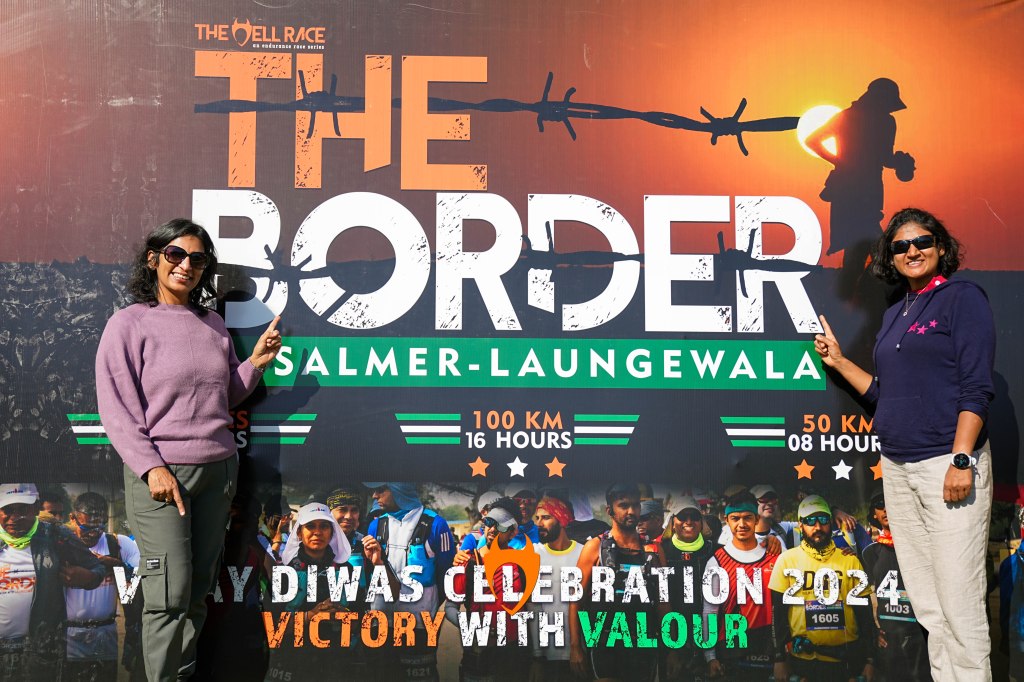
The Border 100: A Tribute to Heroes
The Border 100 was created in 2018 to honor the bravery and sacrifices of Indian soldiers during the Battle of Longewala. In this battle, 120 soldiers from the 23rd Battalion, Punjab Regiment, held their ground throughout the night until reinforcements arrived the next day.
The race has three categories:
- 50 kilometers
- 100 kilometers
- 100 miles (161 kilometers)
I participated in the 100-kilometer category, while Priya, with her vast ultra-running experience, took on the 100-mile challenge.
Race Details
- Starting Point: Indira Gandhi Indoor Stadium, Jaisalmer.
- Start Time: 12 noon.
- Cutoff Time for 100 km: 14 hours (ends at 4 a.m. the next morning).
- Route: The race is a point-to-point route, starting in Jaisalmer and heading towards Longewala—there are no loops.
Challenges of the Race
- Carrying Essentials:
- Hydration points are set up every 10 kilometers.
- Runners must carry everything they need between these points, as external support is not allowed. Accepting any external aid can lead to disqualification.
- Temperature Extremes:
- Daytime temperatures can reach 28–30°C (hot and dry).
- By early morning, desert temperatures can drop to -1°C, making it crucial to prepare for the cold.
- Drop Bag at 60 km:
- A drop point is arranged at the 60-kms mark and 100-kms mark( for 100 milers).
- Runners can change and prepare for the colder hours ahead.
- Drop bags, carefully packed with essentials, must be handed over to the organizers one day before the race.
This race isn’t just about running—it’s about endurance, preparation, and honoring the spirit of those who defend our borders.


The Race Begins
As we walked toward the start line, the race for the 100-milers was flagged off first, followed by the 100-kilometer runners, and finally, the 50-kilometer participants. The start was slow and it is always such a wonderful feeling to be standing with so many ultra runners of India. The camaraderie that ultrarunners share among themselves is so strange as we all wish each other good luck for enduring the pain ahead. 😊
Within the first 300 meters, I caught up with Priya. We were both excited and full of energy. Over the next 2–3 kms, almost everyone overtook us. But we stuck to our slow pace, reminding ourselves with jokes that we’d catch up with them later—at the 50-kilometer or 70-kilometer mark. It was our way of staying positive and motivated.


At the 12-kilometer mark, the sight of massive windmills caught our attention. They looked so majestic and timeless in the desert landscape, adding a touch of beauty to our journey. From then on, till dark, these windmills accompanied us. They are witness to us running together and feeling our happies selves.

The First Five Hours
The brutal sun was relentless, but we were well-prepared. We kept our pace steady, took five salt capsules over five hours, and drank one liter of water every 10 kms. This routine worked well, although it meant I needed frequent loo breaks!
We had an unwritten rule for these breaks: I would keep running for 300 meters watching the runners in front to make sure no one was going behind a bush, then find a suitable spot to relieve myself. At one point, near the 18-kilometer mark, I stepped off the road to find a bush and ended up with sand filling my shoes. I stopped at the 28-kilometer mark to remove the sand, knowing it could cause blisters. After that, I stayed closer to the road to avoid the same mistake.
Rolling Hills and Strategy
The first 35 kms featured rolling hills. We walked every uphill to save energy and ran the downhills, sticking to our plan to conserve strength for the cooler hours ahead. When the sun set, we knew the weather would be more forgiving, giving us a chance to pick up the pace.
We caught up with so many runners at 30 kms mark. Also, we passed so many runners who were struggling with cramps at this stage. We offered water and salt capsules to whoever needed.
Considering we were running on such fresh legs after many months of hard training, it felt so surreal. We kept joking around, looking at various runners with their awesome gear. Some tied 6 rubber bands in their long hair, some were already wearing jacket, some wearing awesome sunglasses and some were no jazz runners with just a t shirt and shorts and water bottle. But all in all, so many runners on a straight long road was a sight which Rajasthan only sees once a year.
From Rolling Hills to Blissful Flats
By 5 PM, after the 35-kilometer mark, the road ahead became mostly flat, and the weather started to ease up. The intense heat of the day was finally behind us, and we could focus on keeping a steady rhythm.
At 6 PM, I witnessed one of the most beautiful sunsets of my life. I removed my goggles( for the first time after 12 noon) and let the moment sink in—the sky was a canvas of red, orange, pink, yellow, and blue. Windmills stood tall around us, the desert stretched endlessly on both sides, and I was surrounded by Priya and so many other runners. These are the moments I live for, where everything feels so perfect and peaceful.
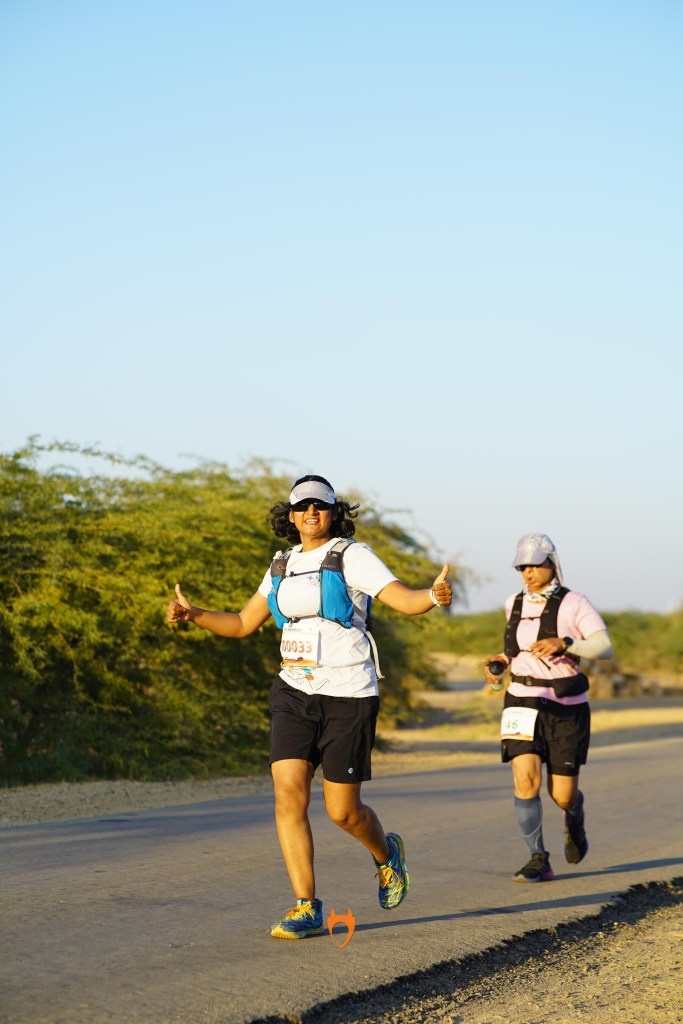
As the sun dipped further, by 6:30 PM, I started to feel a slight chill. Still, I pushed on, determined to maintain our 8:00 mins/km pace, maybe even go a little faster.
At exactly 6:40 PM, I glanced at my watch—we had reached the 50-kilometer mark. I celebratory high-five with Priya. We were right on track, and the feeling of accomplishment was incredible.
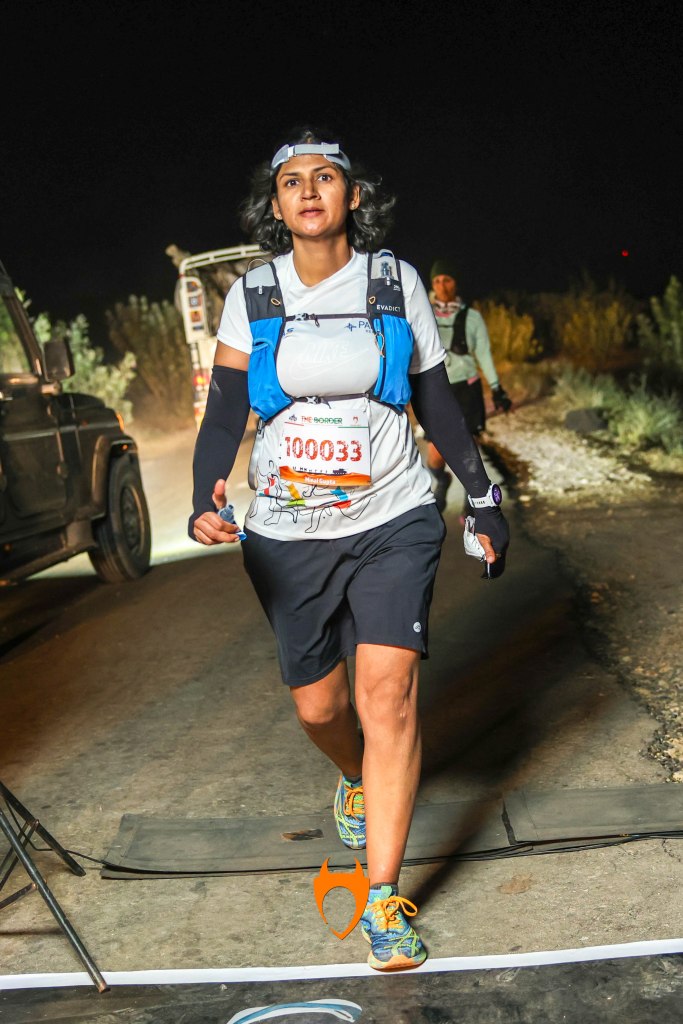
Unexpected Turns at the 52-Kilometer Mark
At the 52-kilometer mark, the organizers informed us that the 100-kilometer participants needed to complete a 500-meter loop (1 kms total) before continuing, while the 100-milers could move straight ahead. This unexpected detour wasn’t part of what Priya and I had planned, but then again, what’s an ultramarathon without surprises?
We quickly adapted. As I started running again, I decided to pick up my pace, hoping to catch Priya at the 60-kilometer mark—the drop bag/changing/hydration/dinner point.
Over the next 8 kms, I crossed paths with a few runners. While I enjoyed their company briefly, I was focused on my goal. I didn’t want to compromise on speed, as all I could think about was reaching Priya at the 60-kilometer mark and continuing our journey together.
At 7:20 PM (with 55 kms done), I wore my arm sleeves to protect myself from cold. The only piece of cloth I added in my first 60 kms.
Under the Full Moon
By 7 PM, it was completely dark, but the full moon lit up the night in a magical way. The sky was studded with countless stars, and the moon shone so brightly that I could clearly see even the tiniest stones on the road.
As I ran, I made it a point to look up at the moon and the sky often, thanking them and God for allowing me to experience this incredible race. Gratitude filled my heart, so deep that no words could ever truly capture it. In that moment, I felt a profound sense of bliss and peace, as if everything was just as it should be.
Reaching the Drop Bag Point
Around 8:10 PM, at the 61.5-kilometer mark, I finally reached the drop bag point. I called out for Priya as soon as I arrived—it felt like the quickest way to find her. Almost instantly, I heard her voice, “Come, Minal, I’m in the changing area.”
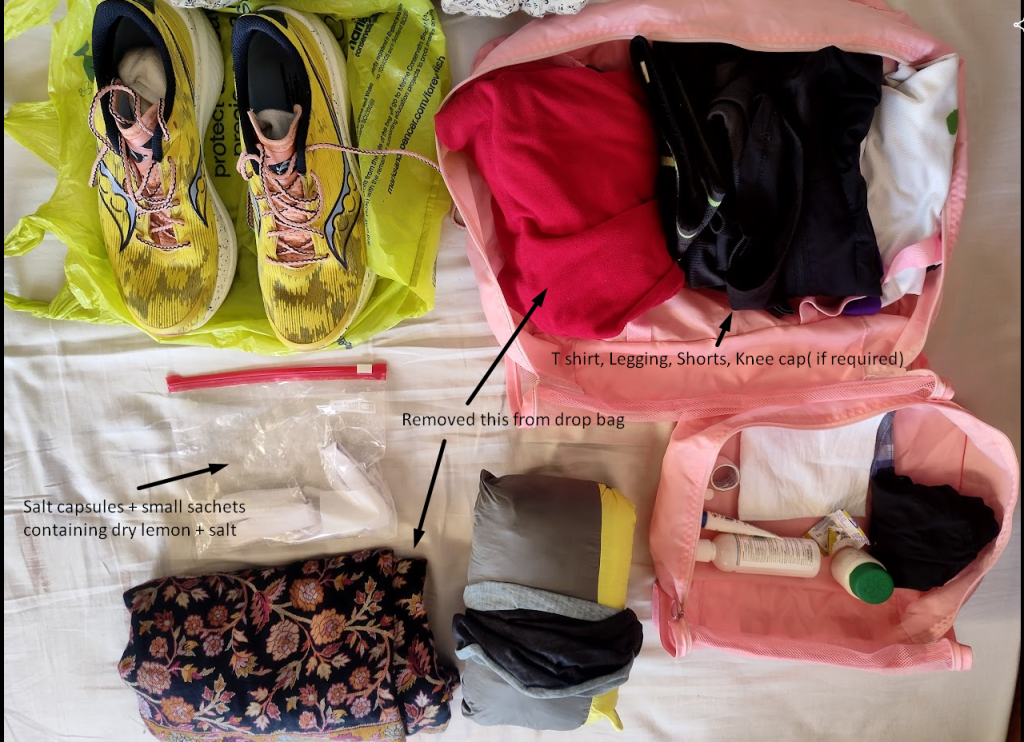
I grabbed my bag and quickly got to work. I changed into leggings layered with shorts, swapped my sweaty t-shirt for a fresh one, and added a thin upper, down jacket, fleece cap, and gloves to stay warm. My back and knee had started to ache, so I sprayed Volini as a precaution to keep the pain at bay.
My hands were cold and unsteady, so I asked a kind woman nearby (who was probably there to support someone else) to help pin my bib onto my shorts. Her willingness to help touched me deeply, and I wished her all the good things from the bottom of my heart.
In the changing area, I also met Rashmi and Sonali. We couldn’t stop laughing over some silly jokes—it’s true that women always bond well in washrooms and changing spaces. Those moments of laughter felt like a warm hug in the middle of the race.
Recharged and Back on the Road
After changing, we quickly grabbed some food—4–5 spoons of dal rice and two cups of tea. The whole stop took about 15 minutes. With warm clothes on, food in our stomachs, and tea to energize us, we were ready to run again.
Surprisingly, I didn’t feel tired at all at this point. I asked Priya how she was feeling, and since she felt okay too, we decided to stick to Plan A, aiming for a pace of 8 mins/km.
The full moon and star-studded sky made the night magical. . I kept glancing at the sky, feeling a deep sense of gratitude. In those moments, I silently thanked God for letting me experience this race. Words can never capture how peaceful and blissful I felt.
Pacing Through Challenges
We maintained our pace well until the 74-kilometer mark. That’s when I suddenly started feeling tired and uncomfortable. My knee and back pain worsened slightly, and I noticed my running pace was dropping to around 7:50 mins/km. Since we were also taking walking breaks, our overall pace dropped to about 8:30 mins/km.
I told Priya not to worry and suggested we continue at 8:30 mins/km until the 85-kilometer mark. From there, we could reassess and decide how to move forward.
A Burst of Energy at 81 Kms
At the 81-kilometer mark, I had 2 cups of tea and a piece of bread with peanut butter. After this, I suddenly felt a surge of energy. By the time I reached the 82-kilometer mark, I was running faster, probably around 7:40 mins/km.
When I reached the 85-kilometer mark, I realized Priya had fallen behind. I stopped and called out her name loudly a couple of times while walking backwards, but soon realized she was far behind. I decided it was best for me to keep going and finish my 100 kms first. I would help her at the 100-kilometer mark, so she could continue with her 100-miler.
With that in mind, I started running again. I felt confident that I could maintain my pace all the way to the 100-kilometer mark. Initially, I was aiming for a time of 1:40 AM.
From 85 to 92 kms, I ran nearly nonstop, with just 2–3 short walking breaks. I felt incredibly strong, confident, blissful, and happy—like everything was aligning perfectly. I experienced a deep sense of joy, peace, and fulfilment, all at once.
The Struggle at 92 Kms
At the 92-kilometer mark, I suddenly felt completely exhausted. My thighs started to hurt, and I decided to fast-walk to keep my pace below 10 mins/km. I was now aiming for 1:42 AM finish.
By 93 kms, the pain in my thighs, knees, and back was intense. I reminded myself that I had experienced similar pain after intense leg workouts, and I had run through it before. Still, I couldn’t run and kept walking.
By 94 kms, I felt incredibly lonely. I missed having Priya by my side. I tried to run but just didn’t have the energy, so I continued walking.I was now aiming for 1:45 AM finish.
At 95 kms, I focused on the beautiful surroundings—the full moon, the starry sky, and the peaceful night. I even asked the moon for some energy to run a little further, but nothing changed. I kept walking.
At 95.5 kms, I remembered how hard we had worked during training, pushing ourselves with long runs over several weeks. Still, the motivation didn’t come, and I kept walking.I was now aiming for 1:50 AM finish.
At 96 kms, I felt dejected. I thought I should have the courage to run, even through the pain, but I couldn’t. That’s when I broke down, but no tears came—perhaps because I was dehydrated. I kept mumbling to myself, “I’m so tired. I can’t go on.” Some runners passed by, but no words of consolation came. I noticed one runner with a limp and decided to stick to walking as fast as I could (10 mins/km).
At 96.6 kms, I thought about the playlist Meenal Kotak had sent me for tough times like this. The idea of getting my phone from the hydration bag felt like too much effort, so I kept walking(10 mins/km).
By 97 kms, I was done. I just wanted a car to come and pick me up. I kept walking, thinking, “I can’t keep going with this pain.” I was trying for 2 AM finish now.
At 98 kms, I was still pitying myself for not being able to run. But I kept walking.
The Final Push
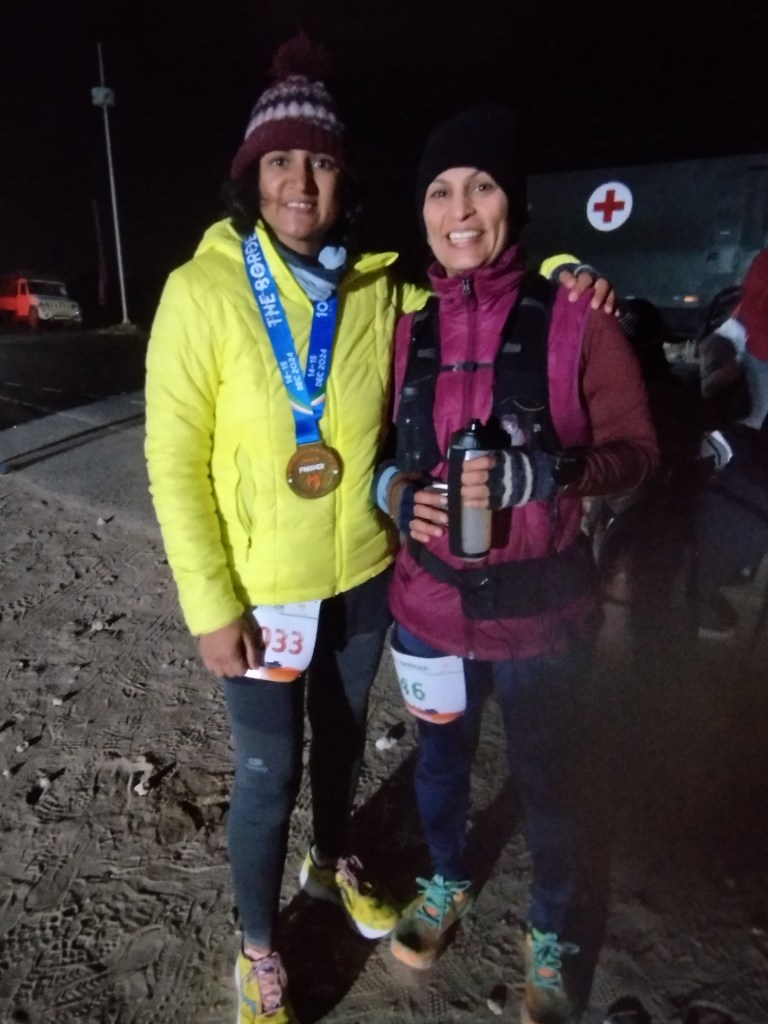
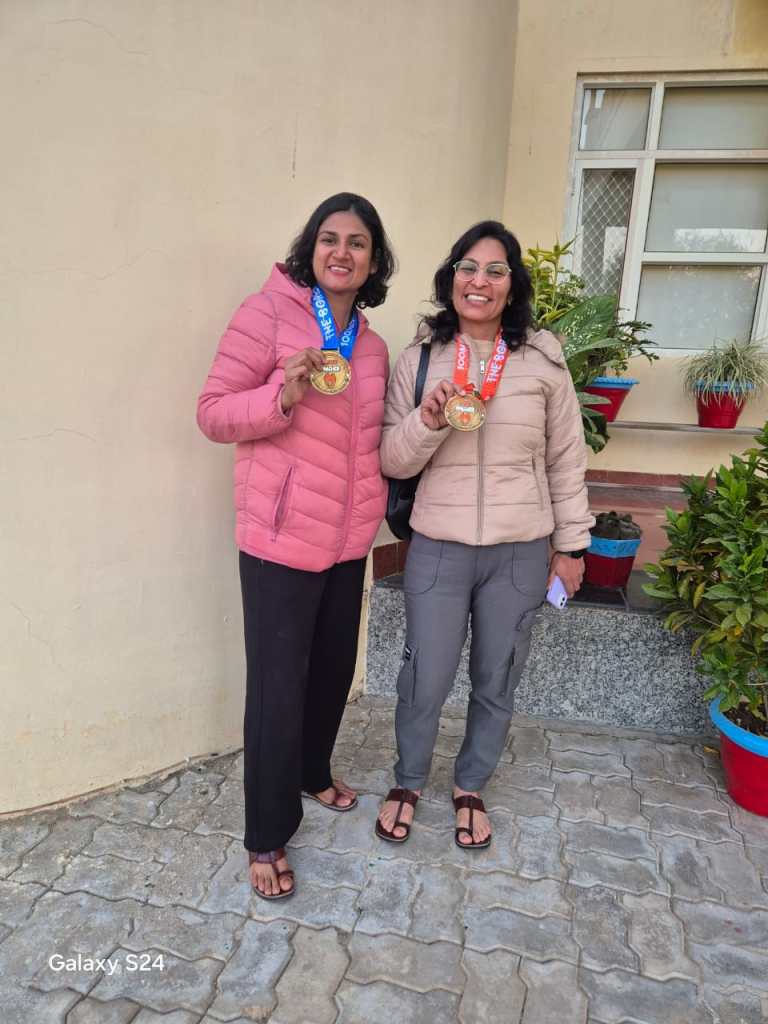
When I hit 99 kms, something changed. I started running, because ENDING matters. I kept running towards the finish line. At 100 kms in my watch, I could see a bright light at a distance and kept gradually increasing my pace till in last 200 mts I sprinted to finally cross that finishing line and heaving a sigh of relief. A beautiful medal awaited to be decorated around my neck right at the finish line.

If you think, I would be relieved. You are so wrong. The wait for Priya kept me so anxious..
Would I do it again ? Of course , because i loved every second of it …



Hydration and Nutrition during the race
Hydration
- First 40 kms: 1 liter of water every 10 kms
- Post 40 kms: 500 ml of water every 10 kms
Salt Tablets
- 5 salt tablets in the first 5 hours
- 1 more salt tablet at the 70-kilometer mark
- Total: 6 salt tablets
Food Intake
- 20 kms: 2 dates, 4 pieces of orange, 4–5 chips
- 30 kms: Snickers, half a banana
- 40 kms: 2 dates, orange, chips
- 50 kms: 2 pieces of chikki
- 60 kms: 4–5 spoons of dal and rice, 2 cups of tea
- 70 kms: 1 Snickers
- 80 kms: 1 slice of bread with peanut butter, cups of tea
- 90 kms: Banana
- 100 kms: Many cups of tea (to keep warm 😊), some food

Important Notes
- Take loo breaks as soon as I felt to make sure the water consumption doesn’t go down.
- Carry only salt tablets + specific ORS/gels you use. I carried salt capsules + packets of dry lemon powder + salt (which I mixed with water at hydration points)
- Do not waste much time at hydration points. Spend 1 mins/hydration point.
- Ask for help at hydration points. Volunteers will refill bottles for you.
- 500 mts from the hydration points, decide what you want to eat. Pick that and eat it while walking away from points. Do not waste time standing and eating at points.
- Carry arm sleeves in the first half. That the only thing I layered on in first 60 kms, don’t carry additional stuff
- Don’t waste much time at drop bag points, change clothes, eat food and move. The more time you waste, the colder you will feel.
- Start slowing in the beginning as the sun really drains out your energy. Save your energy to run post 6 PM, when the weather is cooler.
- In the drop bag points, if there is anything essential that you must carry, keep it in a poly bag, so that you don’t waste timing in finding small things then, carry that bag with you for forward run.
- Keep a hanky. Will come handy to blow your nose.
- Keep warm clothes at 100 kms drop bag, that’s when you feel the coldest.
- Do not forget to look around and appreciate the beautiful setting you are running in.
- Do not load the hydration bag.
- Do not carry any eatables, eat from the hydration points.
- Goggles are must have for initial 6 hours of run.
Race Preparation
- To prepare for the Border 100 km in December 2024, I aimed to complete a 50 km race under 6 hours in the winter of 2024 (Jan–March). However, I was constantly ill during that period and couldn’t register for any stadium run. Instead, Priya suggested a 52 km trail run, which I was initially sceptical about. But I ended up finishing it successfully, and it was only thanks to her great company. Read more about it here
- I ensured that I did 2 weight training sessions/week in evening to keep the upper body strong
- Did 2-3 yoga sessions/week. Later, tried to do 5 sessions/week to increase flexibility and avoid injury.
- In winters, starting from October, we planned 3 long runs 50 kms each and a slightly longer run on second day on tired legs 10-15 kms. Not everything went as per plan. But I am attaching the run log of last 3 months, in case that’s helpful
- We did 1 interval training on Tuesday to keep at some level of speed.

Stretching links
https://youtu.be/yMNLa17g9uc?si=cvyQrNkJEykmpfZp
https://youtu.be/g_tea8ZNk5A?si=gJKAs11O49GTp0gz
https://youtu.be/tnZ96Y2C28Y?si=UMnwcCCv6No0Qe_D
https://youtu.be/CY6QP4ofwx4?si=VGvcCUQ3_xF9DtzW
Gear Info
- First 60 kms Shoes – Asics Noosa tri 15 + 5 toe socks
- Next 40 kms Shoes – Saucony Endorphin Speed 3 ( 1 size bigger) + Bamboo socks
- Running Vest – Bought from Decathlon for Rs 2999
- AONIJIE Soft Water Bottle Pack- 2* 250 mls
- Compression socks
- Shorts – Athlos
- Sports Bra – Nike
None of the above are affiliate links, I spent a lot of time researching on this and than buying these products. So sharing with you all, in case it helps someone.
Rest , we both are coached by @Manjeet and he took care of our training to ensure we were prepared for our respective distances. There is no way I could have finished this distance without his immaculate training. Thankyou Coach.
Special thanks to Taru Ma`am and Mahezabin for sharing training plan and insights into race planning.
Feel free to follow on starva.
Any feedback or comment on this post is a writers delight. Thankyou for reading through.
Categories: Women & Endurance


Inspirational for all Females.We are proud of you Minal. Always stay blessed.
LikeLike
Thankyou so much Ma`am !!
LikeLike
what amazing your journey 100kms . I am really enjoyed a lot during. Wonderful explanation with honesty.
LikeLike
Thankyou so much sir !
LikeLike
a brillantly written blog. i also think for new comers u shld provide details in where u guys stayed and about the food and other costing. might help women and others who are thinking of participating to decide at this bit far off destination…rgds..V
LikeLike
Thankyou ma`am.
Good point.
I stayed in BSF( Border security area) because my friend Priya is serving in Indian forces. We ate most of the meals there only as the food was like home meals. We ate just one meal outside and did not like it. The cost of our stay and food was very cheap. I payed total of around Rs 4000 for the same.
Even otherwise, the stay in Jaisalmer is not costly. If you can book Jaisalmer Heritage Inn, thats better as its the race expo venue also the race start point is 200 mts from there. But you need to book it in advance. Otherwise there are plenty of hotels in Jaisalmer costing in the range of Rs2k-Rs4K and the total distance from any location would not be more than 3 kms as Jaisalmer is a small city.
Sorry, cant recommend about food as I did not like the food outside and I am not a foodie and dont like to experiment with my food. I would just recommend one thing – Do try Bajra ki Roti ka churma, Its Bajra Roti + ghee + jaggery . Its healthy and very tasty there. Hope this is helpful !!
LikeLike
Thanks for sharing your experiences. The longest I have run so far is a marathon, and I intend to do the 50K at the border race in Jaisalmer, 2 years from now. Will train for it and hopefully finish strong.
LikeLike
Thanks for sharing your experience. I intend to do the 50K run 2 years from now. This blog post has been immensely valuable. Good luck and more power to you
LikeLike
I am glad , you found it helpful. Thankyou !
LikeLike